ArriveRoom 1 of 4
Out front on Canoga Avenue
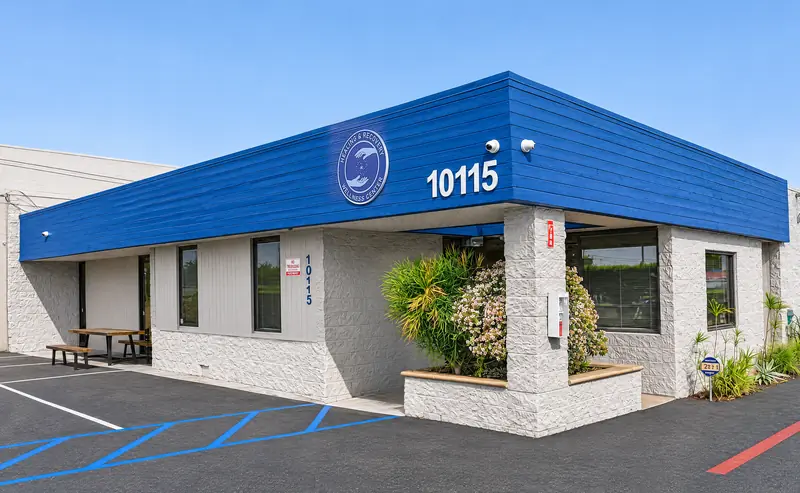
Look for the blue roof line and the number 10115 over the door, on Canoga Avenue in Chatsworth. This is where your first morning in our outpatient program starts.
Admissions line open 24/710115 Canoga Avenue, Chatsworth
Where healing begins · Chatsworth · San Fernando Valley
Our outpatient program is for adults. Come in for group and one-on-one therapy between 9 a.m. and 4 p.m., then go home at night. One team treats drinking, drug use, anxiety and depression together.
Free and private to call about our outpatient program. Our admissions line is open 24/7.
Certified by the State Department of Health Care Services, No. 191478AP, expires 12/31/2026.
Accredited by The Joint Commission, HCO ID 731543.
Healing & Recovery Wellness Center is an outpatient addiction treatment center for adults. We are in Chatsworth, California. We treat substance use at three levels of care, along with the anxiety, depression or trauma that can come with it. In our outpatient program, you come in during the day and sleep at home. Turn the dial to see what changes at each level, and what stays the same.
Compare our 3 levels of care
Pick a level on the dial. Your schedule changes. Your care stays the same.
Most structureMost room for daily life
What the week looks like
You arrive at 9 a.m., and lunch is from 1 to 1:30. On Wednesdays, your case manager can help with paperwork, like DPSS or the DMV. On Fridays, only the first group is required, and then the group goes on an outing or to an outside meeting.You come in for part of the day, on days set with you when you start. Evening IOP groups meet by secure video, and you must be in California during those groups.You come in for 2 hours on your program days, and those days are typically fixed. If you need more support, you can ask to sit in on extra groups.
Most people start here.Some people start here, depending on their diagnosis.Most people step down to OP from IOP.
Read about our PHP →Read about our IOP →Read about our OP →What we treat, for adults
Substance use
Treated in the same plan
Start somewhere else first if
What this showsThe levels differ in how much of your week you spend with us. Your therapist, your doctor and small groups stay the same at every level. Your days and groups are set case by case, based on your needs and what your insurance approves.
means partial hospitalization program. means intensive outpatient program. means outpatient program. Next, meet the people who run our outpatient program.
Now you know what we offer. The next question is who runs our outpatient program. One small team builds one plan with you. Tap a person to see what they do and when you see them.
Leads the center
Executive Director · at the center
Runs the program day
Program Director · registered substance use disorder counselor · at the center
Your therapist
Licensed marriage and family therapist · in person
Your doctor
Doctor · by secure video
Life outside treatment
Case management · at the center
Your groups
Group leaders · in person

See how to check each record yourself →
★★★★★5.0 on Google, from 8 reviewsWritten by people who chose to post them. Checked November 10, 2026.Read them on GoogleNIDA reports that treating mental health and substance use together leads to better health outcomes, which is why one team builds one plan. You can also check the public list of programs on probation. Next, you can see how to get started and verify your insurance.
What this showsWho you’d work with, what each person does, and the public records you can check before you call.
You know what we offer and who you’d work with. The next step is getting into our outpatient program, and it starts with one call. Your safety and fit come first. Your insurance comes after. Move through the four steps.
Step 1
Call (747) 202-3638. Our admissions line is open 24/7.
Step 2
A few questions about what you’re facing and what you need to keep doing, like work or family.
Step 3
Have your photo ID and insurance card nearby. We go over cost and how your plan works with our program on one short call.
Step 4
Intakes for our outpatient program happen on weekdays, between 9 a.m. and 5 p.m.
What this showsWhat happens from your first call to your first day, and where insurance fits in.
Checking your insurance is free, and it isn’t a commitment to start. Next, see what a program day looks like. Read more about verifying your insurance.
Once you start, this is where your days happen. Program days run from 9 a.m. to 4 p.m. Pick a part of the day to see what happens and the real rooms it happens in. Every photo is our own center.
A program day, 9 a.m. to 4 p.m. · pick a part of the day
9:00 a.m. Check in at the front desk and get settled. Say hello and catch your breath before the first group.
9:30 a.m., 11 a.m. and 1:30 p.m. Three groups a day, led by our clinical staff: process, then tools for recovery, then continued growth.
1:00 p.m. A 30-minute lunch. Time to eat, rest and talk with people who understand.
Between groups. Games in the large group room help you move and reset. Music sessions use the music room. Ask what this week’s schedule holds.
Once a week. Private time with your therapist, in person, at every level of care. Sessions fit around your groups.


1/ 3
ArriveRoom 1 of 4
Look for the blue roof line and the number 10115 over the door, on Canoga Avenue in Chatsworth. This is where your first morning in our outpatient program starts.
ArriveRoom 2 of 4
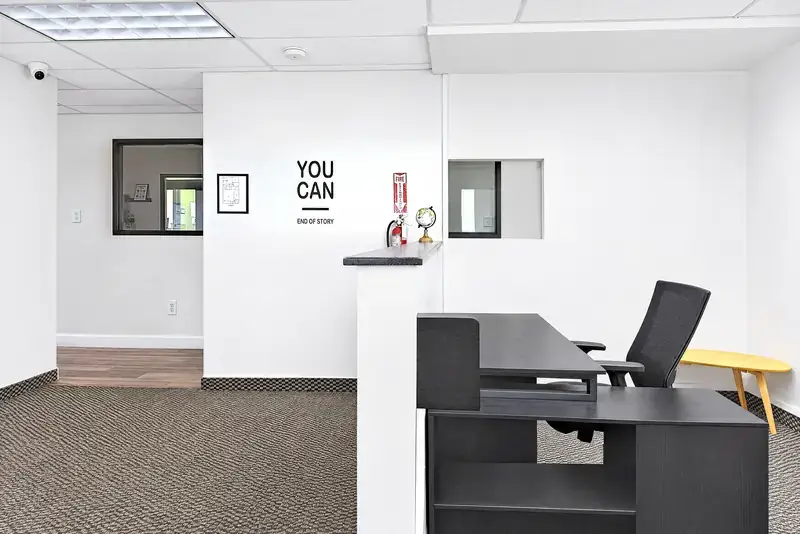
Just inside our front door. Take a seat, catch your breath and let the front desk know you’re here.
ArriveRoom 3 of 4
You check in here each morning. On your first day, this is where you start, and where you can ask anything.
ArriveRoom 4 of 4
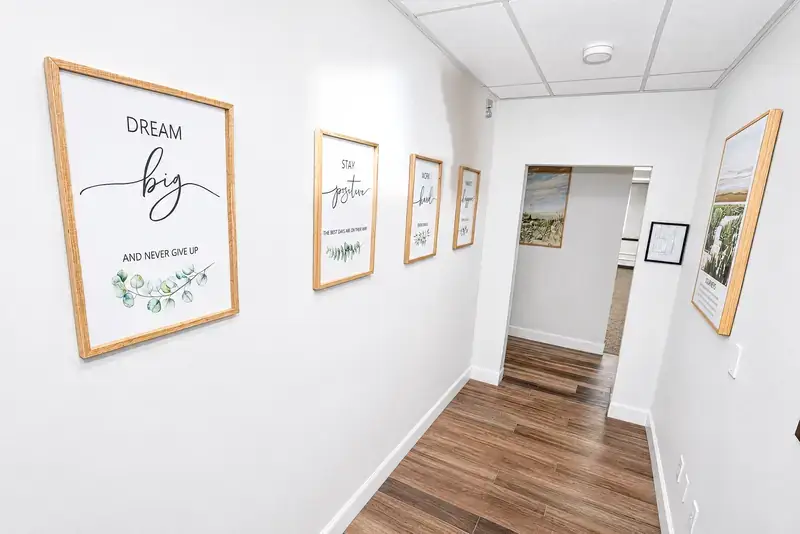
The walk to group. Framed words of encouragement line the walls along the way.
Group therapyRoom 1 of 3
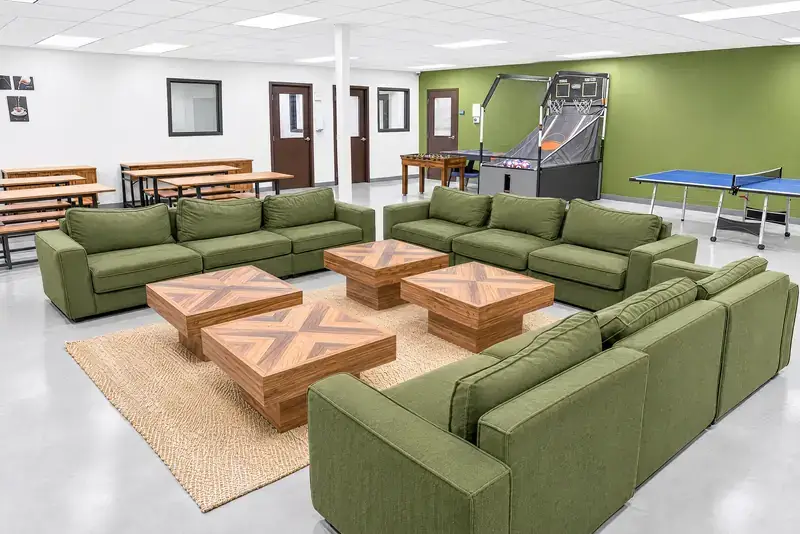
Green sofas around wood tables, with room for a whole group to sit together. Groups meet in this room. It also holds the lunch tables and the center’s games, like ping-pong, basketball, air hockey and foosball, for breaks.
Group therapyRoom 2 of 3
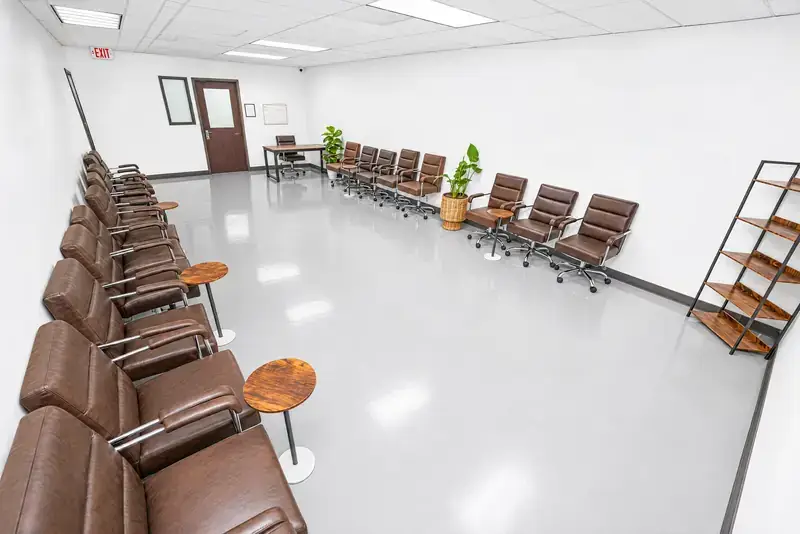
Chairs face each other so everyone can be seen and heard. Process groups, the heart of an outpatient program, meet in a circle like this one.
Group therapyRoom 3 of 3
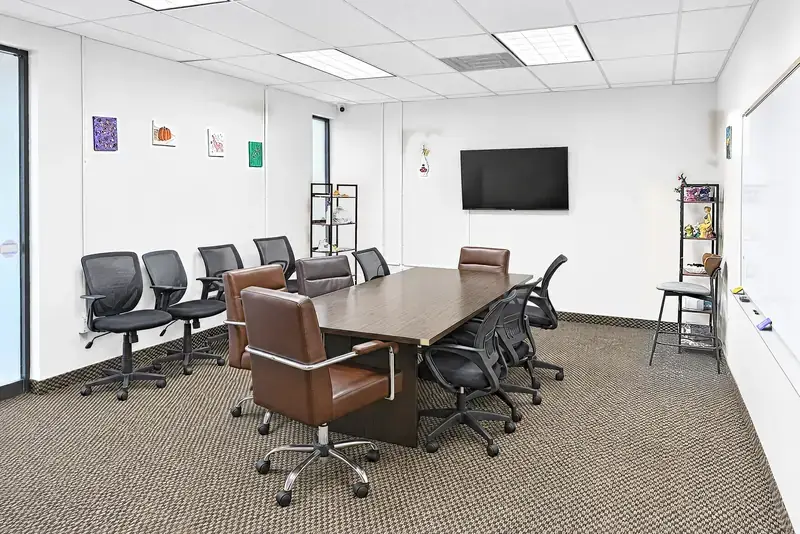
A long table with room to spread out. Skills groups meet here. You practice tools for cravings, stress and daily life and write down your plan.
LunchRoom 1 of 2
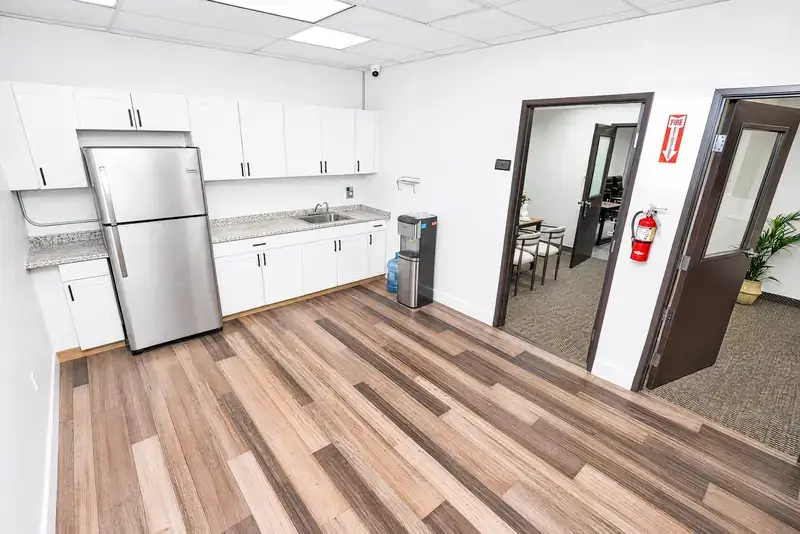
A full kitchen with a refrigerator and a sink. This is where lunch happens each outpatient program day.
LunchRoom 2 of 2
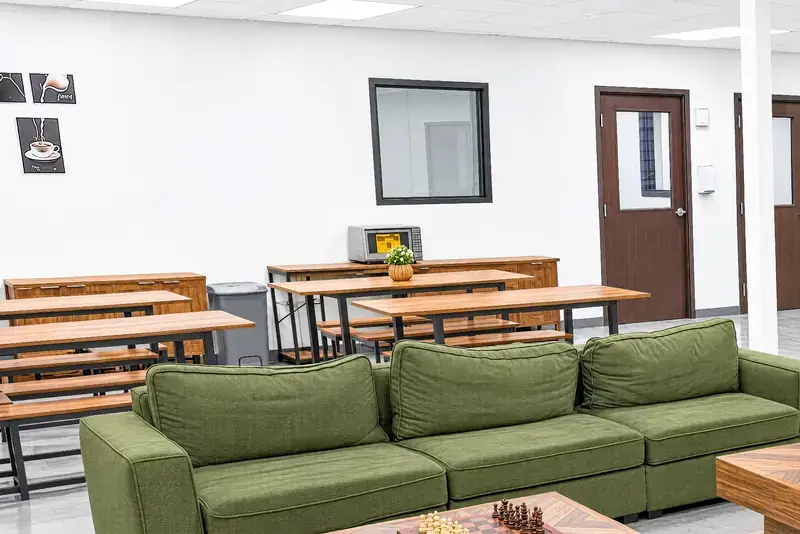
Long wood tables with benches, at one end of the large group room. Lunch here often turns into real conversation.
Breaks and musicRoom 1 of 3
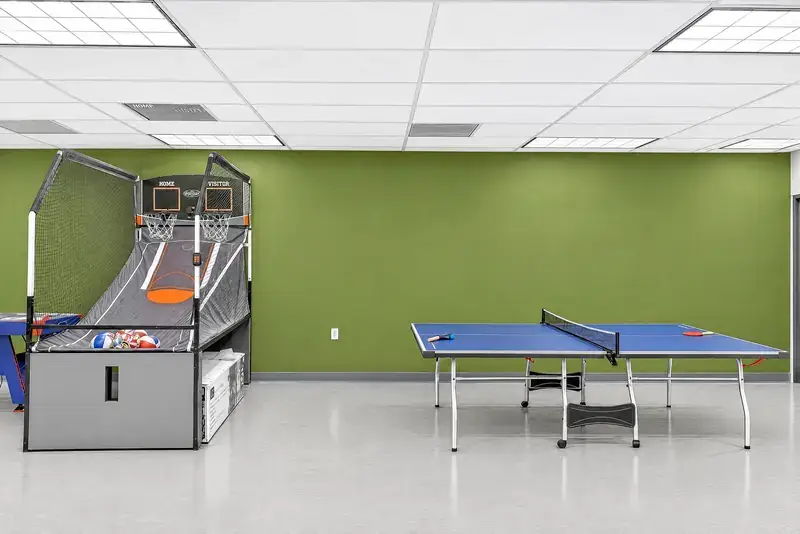
A ping-pong table and a basketball game along the green wall of the large group room, for moving your body during a break.
Breaks and musicRoom 2 of 3
Air hockey and foosball. Laughing with people who get it is part of feeling like yourself again.
Breaks and musicRoom 3 of 3
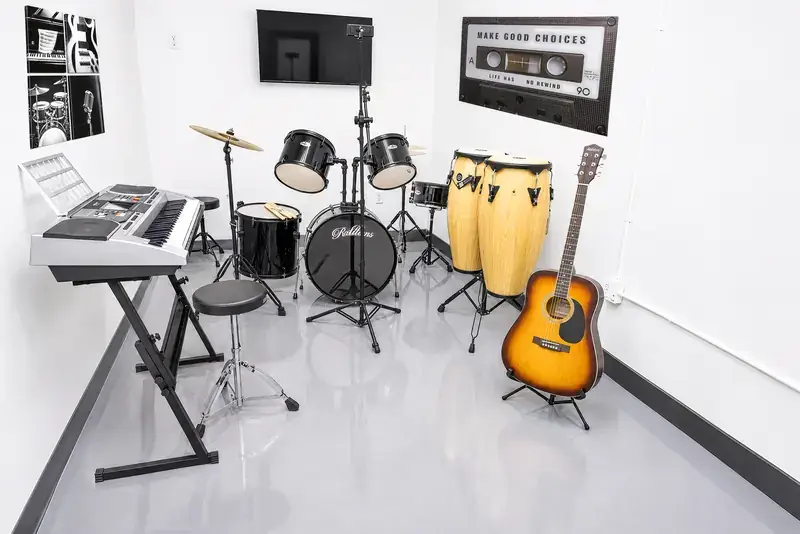
Drums, congas, a keyboard and a guitar. Music sessions let you work through feelings without needing the right words.
One-on-one therapyRoom 1 of 2
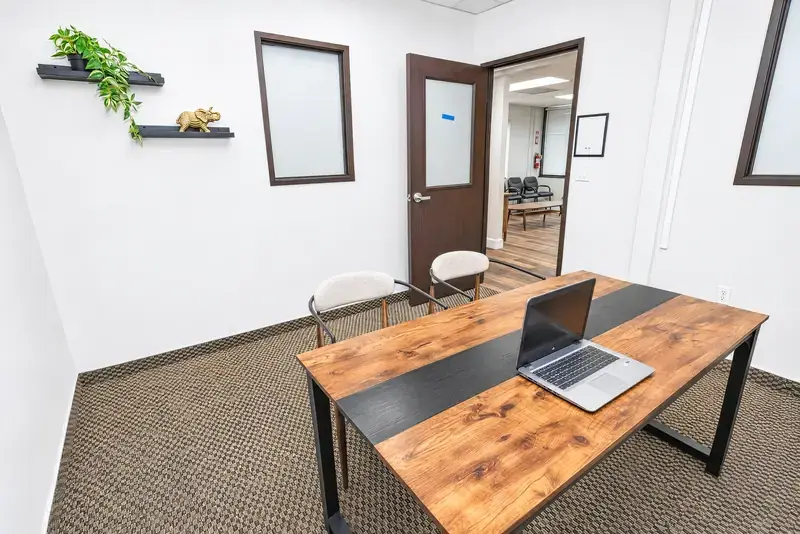
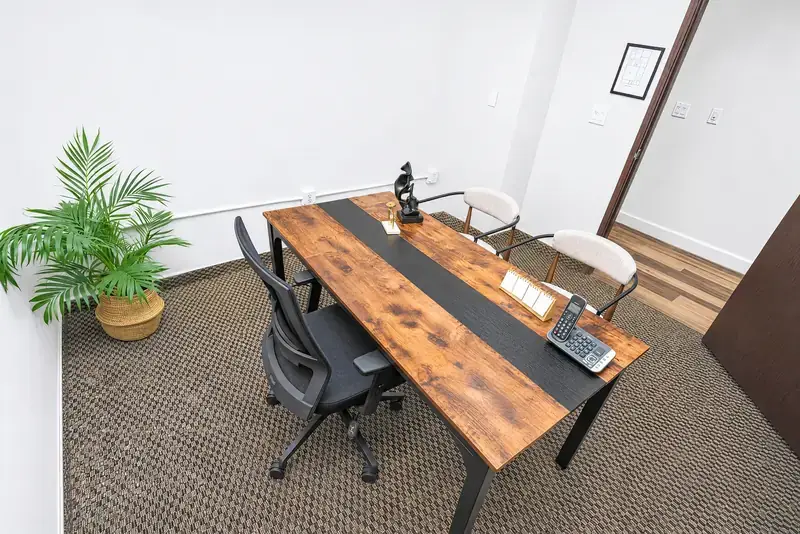
Private time with your therapist, with the door closed. Every level of care includes one in-person session a week with your therapist.
One-on-one therapyRoom 2 of 2
Every office is set up for private conversation. What you share stays private, protected by HIPAA and 42 CFR Part 2.
Rooms for this part of the day
PHP follows the full day. IOP and OP join for part of it. Evening IOP groups meet by secure video, and you must be in California during those groups. On Wednesdays, case managers help with paperwork, like county benefits forms or an ID. On Fridays, only the first morning group is required, and then the group goes out for an activity or a recovery meeting. At 3:30 p.m., everyone helps tidy up, then heads home.
What this showsWhat each part of a program day looks like, and the real room it happens in, so your first day feels known.
Most of a day in our outpatient program is groups, led by our clinical staff. Next, see what each part of care works on.
Each day of our outpatient program is built from the parts of care below. One team treats mental health and substance use together, in one plan. Pick what you’re struggling with most to see which parts of care work on it.
What are you struggling with most?
Urges are a normal part of early recovery. They rise, peak and pass. Here’s what works on them.
Many people used to quiet worry or panic. Care works on the anxiety itself, not just the use.
Feeling flat, sad or numb is common, especially in the first weeks. You don’t have to push through it alone.
Use often strains the people closest to you. Healing those ties is part of treatment, when you’re ready.
Bills, forms and a job can pile up. Care makes room for the practical side of life too.
Weekly private sessions with Sona, using CBT, DBT, motivational interviewing or solution-focused therapy.
Find your own triggers and build a plan around them.
Work on what drives the worry, at your pace.
Space to talk about what’s weighing on you, with someone trained to help.
Sort out what you want to repair, and how.
Most helpful for cravings and urges, anxiety and stress, low mood and tension at home
Matches what you pickedPractice ways to handle urges, stress and hard feelings with peers.
You learn to ride out an urge, step by step, and practice it with peers.
Breathing, calming and thought tools you can use in the moment.
Most helpful for cravings and urges and anxiety and stress
Matches what you pickedReal talk with peers about what’s happening in your life.
Hearing “me too” from others eases shame and isolation.
Practice honest conversations in a supportive room first.
Most helpful for low mood and tension at home
Matches what you pickedOur doctor reviews your medicines by secure video, when they’re part of your plan.
Ask whether an FDA-approved medicine for alcohol or opioid use fits your plan.
Have your anxiety medicines reviewed by a doctor who works with your therapist.
Check whether medicine for depression belongs in your plan.
Most helpful for cravings and urges, anxiety and stress and low mood
Matches what you pickedWith your signed consent, the people you choose join a session with Sona and our clinical staff.
Everyone hears the same information and leaves with a plan for home.
Most helpful for tension at home
Matches what you pickedCreate and express what’s hard to put into words.
Calming, hands-on time that settles your body.
A way to feel something good again without forcing words.
Most helpful for anxiety and stress and low mood
Matches what you pickedHelp with county benefits paperwork, IDs and work notes, during the week.
Get help with forms, IDs and notes for work, so they don’t pile up while you’re in care.
Most helpful for work and paperwork
Matches what you pickedRoutines, budgeting, communication and planning.
Build routines and a budget you can keep after the program day ends.
Communication skills you can use at home that night.
Most helpful for work and paperwork and tension at home
Matches what you pickedWhat this showsWhich parts of care work on what you’re struggling with, so treatment feels less like a mystery.
NIDA says are the care used most often. SAMHSA calls medicine plus therapy a “” approach. If a crisis comes up, our team is trained to help you through it. Next, see if your plan can help pay.
Sources for this sectionNIDASAMHSA
Next06 · Check benefits↓Many plans pay part of the cost of an outpatient program. Depending on your plan, we may be an provider. Send your plan, and admissions checks it for you. It’s free, and it isn’t a commitment to start.
Plans people ask us about
Seeing a name here doesn’t mean your plan will pay. Depending on your plan, we may be an out-of-network provider. versions of these plans can’t be accepted.
Plans we can and can’t accept
On an HMO or Medi-Cal? Please keep looking for care. LA County’s free helpline, 1-844-804-7500, connects people with programs that take Medi-Cal, and FindTreatment.gov lists programs for any plan.
A federal law called parity means most plans can’t make limits on addiction treatment stricter than limits on other medical care.
Free · Private · No commitment
Send your plan. Admissions asks your insurance company what it may pay for our outpatient program. On weekdays from 9 to 5, you usually hear back within an hour.
Please leave health details out of this form. You can share them on the phone. Handled under HIPAA and 42 CFR Part 2. Rather talk it through? (747) 202-3638, 24/7.
What this showsWhether your plan may help pay for our outpatient program, and how to send it for a free check.
Prefer to talk? We can check your plan for our outpatient program on the phone, any weekday. Next, find answers to common questions.
A few questions still come up for people who are new to this. Details about each level, cost and calling live on their own pages. Search or tap a topic to jump.
New to treatment
If you’re drinking or using now, or in withdrawal, our protocol is detox first. Withdrawal can make you very sick, so it needs medical care before an outpatient program begins. We don’t provide detox, but we can help you find a detox program. If someone has a seizure, trouble breathing or won’t wake up, call 911.
Yes. Our admissions team can help you look for a detox program, even though we don’t provide detox ourselves. The line is open 24/7 at (747) 202-3638. After detox, our outpatient program in Chatsworth can be your next step. You can also search FindTreatment.gov, a free federal listing of programs.
Not at our center, because we don’t admit people for mental health alone. We treat anxiety, depression and trauma together with substance use, in one plan. If substance use isn’t part of what you’re facing, FindTreatment.gov can show you other programs. If you’re in crisis, call or text 988, day or night.
Your care team recommends a level of care after an assessment. An assessment is a private talk about your history, your health and your goals. Most people start in our partial hospitalization program, and some start in our intensive outpatient program. You talk it through with us before anything is set.
Research supports outpatient addiction treatment, but no program can promise results. One 2014 research review found these programs “as effective as inpatient treatment for most individuals.” NIDA research says most people need 3 months or more of care. Results differ from one person to the next, and many things play a part.
Getting started
You don’t need a referral to call us. You can reach our admissions team yourself at (747) 202-3638, at any hour. Doctors, therapists and case managers also refer people to us. Either way, our team completes its own assessment, so the level of care you’re offered follows what you need and not who sent you.
Yes. Coming back to treatment is common, and it isn’t a failure. NIDA explains that relapse rates for substance use look a lot like those for other long-term illnesses. A relapse can be a sign to restart or adjust treatment. Your plan can build on what you’ve already learned.
No. Nobody in our program is forced to share in group therapy. You can listen until you feel ready. Groups have 15 people at most. If you need to, you can meet one-on-one with your therapist before your first group, so a familiar person already knows your story when you walk in.
Start by checking that the program has a current state license or is certified by the state. Then ask what care it gives. SAMHSA lists five signs to look for: a license, medicine, therapies backed by research, family care and ongoing support. You can also check the DHCS list of programs on probation.
Hours and access
Yes, we run evening intensive outpatient groups by secure video. You must be in California during those groups. Our daytime program meets in person in Chatsworth, Monday to Friday, 9 a.m. to 4 p.m. We don’t run weekend groups. Call and we can talk through whether evening care fits your needs.
No. Our outpatient program is offered in English. If you need care in Spanish, FindTreatment.gov lists other programs, and LA County’s helpline at 1-844-804-7500 can connect you with programs nearby. We’re glad to help you look when you call our admissions line, so please reach out either way.
Yes. Our outpatient program is at 10115 Canoga Avenue in Chatsworth, in the San Fernando Valley. We’re close to Northridge, Porter Ranch, West Hills and Granada Hills. Chatsworth Station is about a 14-minute walk away. Metrolink, Amtrak and the Metro G Line all stop there. Get directions.
No match. Call us at (747) 202-3638 and ask a real person.
Last reviewed November 2026. This page shares general information, not medical advice.


Recovery is possible. NIDA puts it plainly: “addiction is a treatable disorder.” Whether you’re ready to start our outpatient program or just have questions, our admissions team can talk it through with you.
Visit us
10115 Canoga Avenue, Chatsworth, CA 91311Monday to Friday, 9 a.m. to 4 p.m. Close to Northridge, Porter Ranch, West Hills, Canoga Park and Simi Valley.
Get directions below ↓ Or contact us →Where are you coming from?
Directions from Northridge Use my current location in Google MapsFirst day? Program days start at 9 a.m., so plan to arrive a little early.
Leaving detox or another program? Call us before your discharge date, so we can talk through your next step.
Schematic map, not to scale. Google Maps gives you turn-by-turn directions.
When you arrive
For a medical emergency, dial 911.
For a mental health crisis, the 988 Lifeline takes calls and texts day and night. SAMHSA’s National Helpline, 1-800-662-4357, is free and confidential.
Certified by the State Department of Health Care Services, No. 191478AP, expires 12/31/2026.